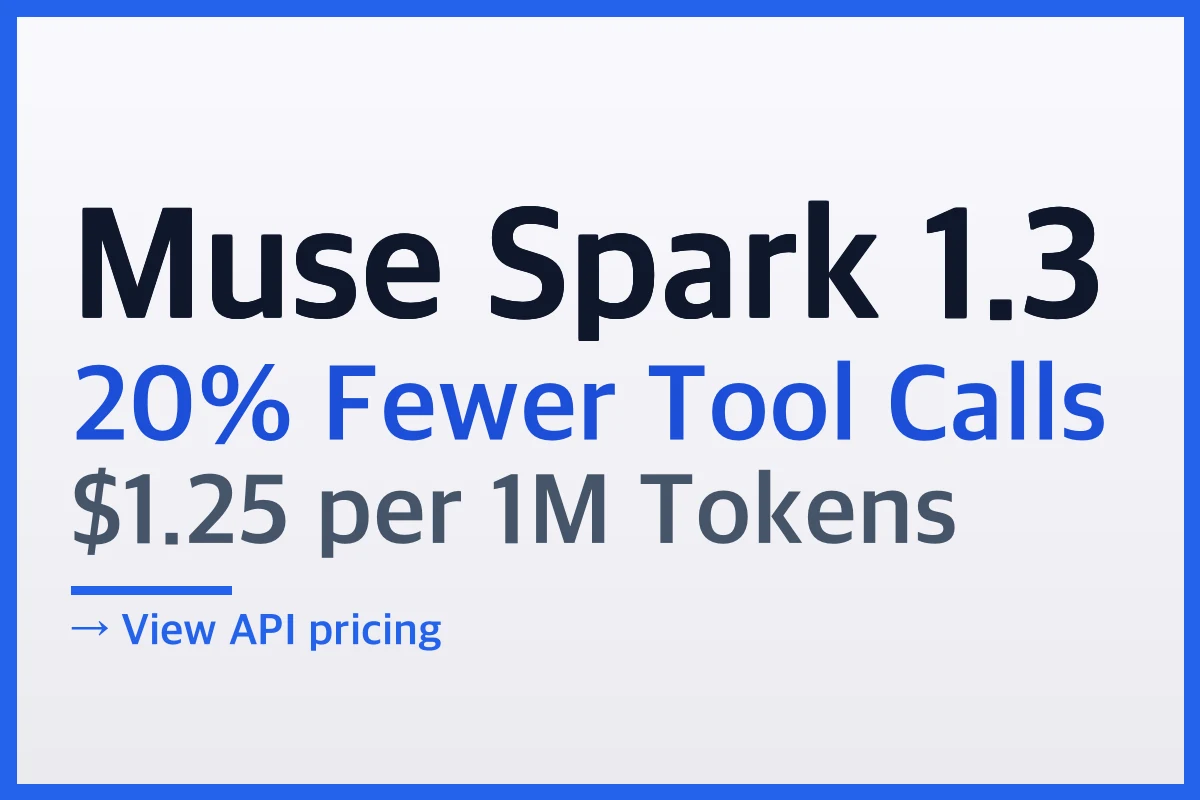
Meta released Muse Spark 1.3 on September 2, 2026, and it is available now through Muse Code, Meta’s coding agent, and the Meta Model API. Compared with Muse Spark 1.2, Meta says the new model uses about 20% fewer tool calls and about 25% fewer tokens on coding work, while standard API pricing stays at $1.25 per million input tokens and $4.25 per million output tokens. Details below were checked in September 2026 against Meta’s own announcement and Meta Model API pricing documentation.
What Meta Announced on September 2, 2026
Muse Spark 1.3 is the newest model in Meta’s Muse Spark line from Meta Superintelligence Labs. Meta positions it for long-horizon coding and agentic work, meaning tasks where a model plans, calls tools, and keeps going across many steps instead of answering one prompt.
The launch covers two access points:
- Muse Code: Meta’s coding agent, installed on macOS and Linux with an install command
- Meta Model API: the developer API, with developer sign-up handled through Meta’s developer site
Meta’s announcement describes the model as available with max reasoning in both places. Some third-party coverage says developers initially get the xhigh variant and that max is gated behind more safety testing. Because sources disagree, check the reasoning levels listed in your own Muse Code or API model picker before relying on either one.
The model is also listed on OpenRouter under the identifier meta/muse-spark-1.3, so developers who already route through that service can call it there.
What Changed From Muse Spark 1.2
Meta describes the update as a behavior and efficiency upgrade rather than a new product tier. The changes it highlights are:
- Fewer tool calls and tokens: roughly 20% fewer tool calls and 25% fewer tokens than Muse Spark 1.2 in Meta’s internal comparisons, with cleaner code and fewer turns
- More collaboration: the model is trained to ask clarifying questions and to check in with the user instead of guessing
- Better multitasking: it maps prompts to the right task more reliably when several workflows share one long thread
- Better self-awareness: improved calibration about what it can and cannot do, which is meant to reduce confident wrong answers
- Stronger safety behavior: better resistance to prompt injection, better handling of irreversible actions, and more judgment in long agentic runs
Meta reports that 1.3 outperforms 1.2 across agent, coding, instruction-following, and long-context evaluations, and it compares the model against GPT 5.6 Sol and Opus 5 at their max settings. Those figures come from Meta’s own scorecard, so treat them as vendor-reported until independent testing catches up.
Reported Benchmark Numbers
Third-party coverage of the launch, citing the xhigh setting, lists these scores:
| Benchmark | Muse Spark 1.3 (xhigh) |
|---|---|
| DeepSWE v1.1 | 75.4 (Claude Opus 5 listed at 74.0) |
| OSWorld 2.0 | 57.2 |
| Terminal-Bench 2.1 | 88.8 (tied with GPT-5.6 Sol) |
| Long-context retrieval (256K to 512K) | 98.5 |
The context window is about 1 million tokens, and the model accepts text, image, and video input. Weights are closed, so you cannot self-host it.
Muse Spark 1.3 Pricing
Meta’s Meta Model API pricing page lists the same standard rates for Muse Spark 1.3, 1.2, and 1.1. The upgrade therefore costs nothing extra per token. Prices are per million tokens in USD, as checked in September 2026.
| Tier | Cached input | Input | Output |
|---|---|---|---|
| Standard (muse-spark-1.3) | $0.15 | $1.25 | $4.25 |
| Contributor (muse-spark-1.3-contributor) | $0.002 | $0.10 | $0.20 |
Other line items on the same page include web search grounding at $2.50 per 1,000 search queries. Published rate limits are 3,000 requests per minute and 4,000,000 tokens per minute on the standard tier, and 100 requests per minute and 3,000,000 tokens per minute on the contributor tier.
What the Contributor Tier Really Costs
The contributor endpoint is far cheaper, at about 92% less on input and about 95% less on output. The trade is that you give Meta permission to use your prompts and completions to train future Meta models. The model capability is the same.
That makes it a poor fit for client code, confidential architecture, unreleased features, or personal data. An NDA with a client does not automatically give you the right to send their material to a training-enabled endpoint. Use the contributor tier only for public or expressly approved material, and read the account screen and agreement before enabling it.
Who Can Use It and How to Try It
The launch is aimed at developers and coding-agent users, not at casual chatbot users. Meta’s announcement lists no geographic restrictions, but it also does not describe a free tier. I did not find a confirmed free allowance for Muse Code in Meta’s documentation, so plan on paid API usage.
- Try it in Muse Code. Install Muse Code on macOS or Linux using the install command from Meta’s announcement, select muse spark 1.3, and set the reasoning level.
- Or call the API. Sign up for the Meta Model API on Meta’s developer site, request the model ID muse-spark-1.3, and pass the reasoning level as a parameter.
- Or use OpenRouter. If you already have an OpenRouter key, use the model identifier meta/muse-spark-1.3.
- Start on the standard tier for anything private, and reserve the contributor tier for public code.
Meta’s own announcement names only Muse Code and the API as launch surfaces. I did not find official confirmation that Muse Spark 1.3 has rolled out to consumer apps, so do not assume you can select it in a chat app yet.
Should You Switch From Muse Spark 1.2?
If you already run Muse Spark 1.2 in agent workflows, the case for testing 1.3 is simple: the price per token is identical, and Meta claims the same job takes fewer tokens and fewer tool calls. If those claims hold on your workload, your bill and your latency both drop.
A sensible way to test is to replay a handful of real tasks on both model IDs and compare total tokens, tool calls, and whether the output needed edits. Confirm current pricing and reasoning options on Meta’s pages before committing, because model versions and rates can change within weeks.
Muse Spark 1.3 FAQ
When was Muse Spark 1.3 released?
Meta released Muse Spark 1.3 on September 2, 2026, through Muse Code and the Meta Model API.
How much does Muse Spark 1.3 cost?
The standard tier costs $1.25 per million input tokens, $4.25 per million output tokens, and $0.15 per million cached input tokens, as checked in September 2026. The contributor tier costs $0.10 input, $0.20 output, and $0.002 cached input, in exchange for letting Meta train on your data.
Is Muse Spark 1.3 free to use?
Meta’s documentation does not describe a free tier for the model. Access is through Muse Code or the paid Meta Model API, so budget for usage-based billing.
Clear, fact-checked guides on money, tech and everyday decisions.
Related reading
- Claude Fable 5.1 and Mythos 5.1: 3 Breaking API Changes Developers Must Fix
- Claude Sonnet 5’s 1M-Token Context Window Explained
- AI Pricing Changes September 1, 2026: What Changed
More on this topic: all AI Tools articles · full article index